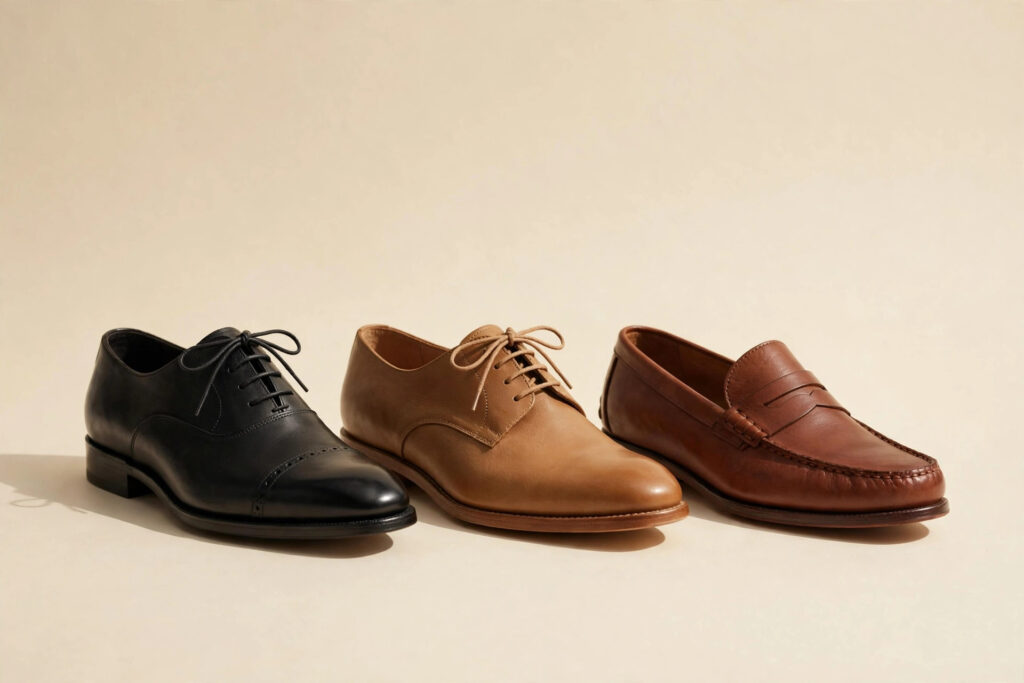
If you are buying your first pair of dress shoes, get a Derby. Its open lacing fits more feet comfortably, it works with everything from a suit to dark jeans, and you can buy a genuinely good one for around $200. An Oxford looks sharper with tailoring but is less forgiving. A loafer is the easiest to wear day-to-day, but the weakest choice for formal occasions.
Three silhouettes dominate the dress shoe world — the Oxford, the Derby, and the loafer — and most of the confusion around buying dress shoes comes from not knowing which one actually suits your life. Shops will happily sell you any of them. This guide breaks down what each one is, how formal it really is, what to check before you spend your money, and which one deserves your first purchase.
The Oxford: the most formal option
The Oxford is the dress shoe purists reach for. Its defining feature is a closed lacing system: the quarters (the side panels with the eyelets) are stitched under the vamp, so the lace-up area sits tight and clean with no gap. That small construction detail is what makes the whole shoe look sleeker and more formal.
An Oxford in black, with a plain cap toe, is still the correct answer for weddings, funerals, interviews, and any occasion where you would wear a dark suit. That is its home turf, and nothing else beats it there.
The trade-off is fit. Closed lacing does not flex, so if you have a high instep or a wide forefoot, Oxfords can bite across the top of your foot. Sizes run true-to-size for most makers, but a wider foot will often need a wide (E or F) fitting rather than squeezing into the standard D.
The Derby: the one most men actually reach for
The Derby is the Oxford’s less fussy sibling. The quarters are stitched on top of the vamp, creating an open lacing system that flexes when you tighten the laces. It is a small difference in construction and a large difference in comfort and versatility.
Because the lacing opens up, Derbies accommodate more foot shapes — high insteps, slightly wide feet, feet that swell through the day. A brown or burgundy Derby in a smooth calf leather will take you from the office to dinner to a smart-casual evening without looking out of place anywhere. With a suit it reads as correct; with chinos or dark denim it reads as intentional.
This is why the Derby is the sensible first buy. It covers the most ground per dollar. If your wardrobe is not suit-heavy — and for most people it isn’t — the Derby earns its rotation slot five days a week instead of five times a year.
The Loafer: effortless, but know its limits
The loafer has no laces at all — you step in and go. Penny loafers, with their signature strap across the vamp, are the most common; tassel loafers add a bit of personality; plain apron loafers keep things minimal.
Loafers are the easiest dress shoe to wear well. They work with tailored trousers, chinos, and even shorts in warm weather. They are also the least formal of the three by a clear margin. A loafer with a suit is a style choice, not a default — it works when the suit is soft-shouldered and the setting is relaxed, but it will look underdressed next to a sharp, structured suit.
Fit-wise, loafers need to be snug at the heel. A little heel slip on the first wear is normal — leather stretches — but if your heel is lifting freely on day one, the shoe is too big. Socks or no socks is your call; if you go sockless, use no-show liners to protect the lining and your feet.
Oxford vs Derby vs Loafer at a glance
- Formality: Oxford (most formal) → Derby (middle) → Loafer (least formal)
- Fit forgiveness: Derby is the most accommodating; Oxford the least
- Versatility with casual clothes: Loafer and Derby tie; Oxford trails
- With a dark suit: Oxford wins, Derby is acceptable, loafer is a deliberate style choice
- Easiest first purchase: Derby, by a comfortable margin
What to check before you buy
Whatever silhouette you choose, the same four things separate a good buy from money down the drain.
1. Construction: how the shoe is put together
This is the single most important thing you are paying for. Three methods dominate:
- Goodyear welted: the sole is stitched to a welt, which is stitched to the upper. A cobbler can resole the shoe for roughly $75–$150, and the shoe can last 10–20 years with care. This is the construction to look for in any shoe over $200.
- Blake stitched: the sole is stitched directly to the upper. Sleeker profile, common in Italian makers, resoleable but trickier — budget $50–$100 and find a cobbler who handles Blake construction.
- Cemented (glued): the sole is glued on. Once the sole wears through, the shoe is effectively finished. Most shoes under $100 are built this way. Fine for experimenting with style; a poor investment for a shoe you want to keep.
A $200 Goodyear-welted Derby that you resole twice is cheaper per year than three pairs of $80 glued shoes. That is the math that matters.
2. Leather: full-grain or nothing
Full-grain leather is the top cut of the hide — it ages, creases cleanly, and develops character. Corrected-grain leather (often labeled “genuine leather”) has been sanded and coated to hide flaws; it looks shiny on the shelf and cracks within a couple of years.
Smooth calfskin is the safest choice for a first pair. Avoid patent leather unless you are buying for black-tie events. Suede is beautiful and forgiving with scratches, but keep it out of rain until you have treated it with a waterproofing spray.
3. Fit: the rules that actually matter
- Toe room: you want about a thumb’s width — roughly 1 to 1.5 cm — between your longest toe and the end of the shoe.
- Width matters more than length: most fit problems are width problems. If the leather bulges hard over the sides of the shoe, go up a width, not a size.
- Heel grip: your heel should feel held. Minor slip in a new leather shoe is normal; floppy is not.
- Shop in the afternoon: feet swell through the day. Shoes bought at 9 a.m. often feel tight by 6 p.m.
- Expect a break-in: a good leather shoe needs 5–10 wears to mold to your foot. Sharp pain is a bad fit, not a break-in — do not power through it.
4. The price bands
Under $100: cemented construction, corrected-grain leather. Good enough to test whether you actually wear dress shoes. Brands like ASOS and budget lines sit here — manage expectations accordingly.
$200–$350 — the sweet spot: this is where Goodyear-welted construction starts. Meermin (roughly $210–$260) and Thursday Boot Company (roughly $200–$250) are the names people cite most often, and they earn it — full-grain leather, welted soles, honest value. Loake’s 1880 line sits at the top of this band.
$450 and up: you are paying for finer finishing, better leather selection, and name heritage. Allen Edmonds (the Park Avenue Oxford runs about $425–$495), Crockett & Jones (from around $600), and Carmina (roughly $500–$650) are the established players here. The jump in quality over the $200–$350 band is real but diminishing — you are buying refinement, not a different universe.
So which dress shoe should you buy first?
Match the shoe to the wardrobe you actually have:
- Your week is mostly suits or formal events: buy a black cap-toe Oxford. Nothing else does the job as well, and skimping here is the one place where cheap shows.
- Your week is a mix of office, dates, and weekends (most people): buy a brown or dark-brown Derby in smooth calf. It is the most useful dress shoe you will own.
- You dress casually and want one “grown-up” shoe: buy a dark brown penny loafer. You will actually wear it.
- You already own one of the above: buy the one that covers the situations your current pair cannot.
One more piece of buying advice that applies to all three: budget another $15–$25 for cedar shoe trees. They absorb moisture, hold the shoe’s shape, and roughly double the life of the leather. It is the highest-return accessory in footwear.
FAQ
Are Oxfords more formal than Derbies?
Yes. The Oxford’s closed lacing system makes it the most formal lace-up shoe, and it is the traditional choice with a dark suit. The Derby’s open lacing is slightly more relaxed and works across a wider range of outfits.
Can you wear loafers with a suit?
You can, but it depends on the suit and the setting. A loafer works with a softer, less structured suit in a relaxed setting. With a sharp, structured suit for a formal event, an Oxford or Derby is the safer call.
How much should a first pair of dress shoes cost?
Plan on $200–$350 for a first pair worth keeping — that is where Goodyear-welted construction and full-grain leather begin, with strong options from Meermin and Thursday Boot Company. Under $100 buys cemented shoes that are difficult to resole; over $450 buys finer finishing with diminishing returns for a first pair.
How do I know if dress shoes fit properly?
Leave about a thumb’s width (1–1.5 cm) in front of your longest toe, make sure the width does not strain the leather, and check that your heel feels held. Fit width before length, shop in the afternoon when your feet are slightly swollen, and remember that 5–10 wears of break-in is normal — sharp pain is not.
Are Goodyear-welted shoes worth it?
For shoes you plan to keep, yes. A resole costs roughly $75–$150, and a welted shoe can last 10–20 years with basic care. The cost per year ends up lower than replacing glued shoes every couple of years.